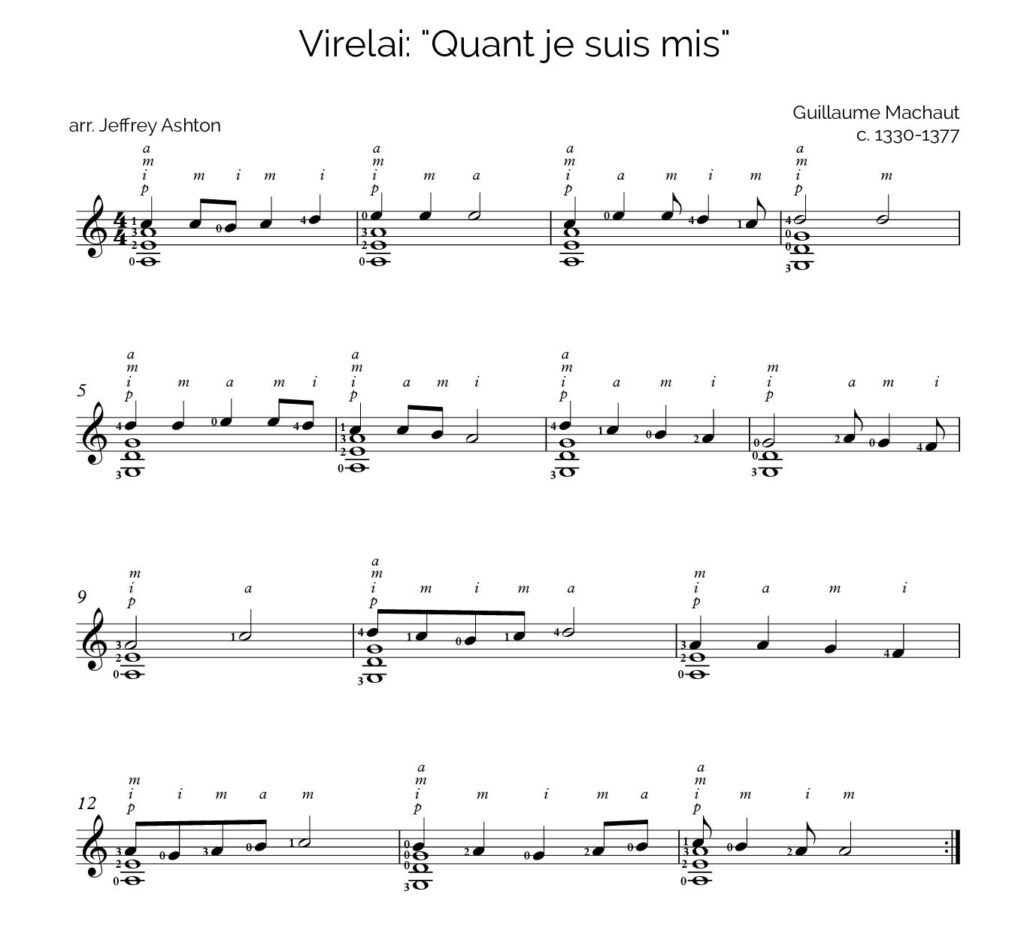
20 years ago my brief stint as a guitar player was for a time extended when I picked up a classical guitar and found a couple decent books of early music to hold my flagging interest. You see, playing black metal is kind of boring since all I wanted to do was tremolo pick simple minor key scales. But the classical guitar was a whole new world of proper posture, technique, and, because classical guitarists like to lord it over the majority of guitarists slumming it with tablature, reading music. I lasted another year before life and other interests saw me shelving my guitar for a couple decades. I’d get it out to pluck around on but never any kind of regular play…until a couple month ago when I decided that having a full time job and family was a good time to pick up an old time consuming hobby–and signed up for proper classical guitar lessons.
I’m still only somewhere in the low end of intermediate, but I have to say that seeing solid progress has really helped keep me interested in playing. The other thing that has kept me interested is a steady stream of new early music snatched from the internet for me to learn about 75% of before moving on to the next song. One of my favorites was a simple song that I thought was called “Virelai” by a composer from the 1300s, Guillaume Machaut. It was super easy, first of all, but more importantly, it sounded medieval as FUCK, so I did a deep dive and found as many of his songs as possible to try to assemble a collection of my favorites.
Rather than paraphrase, here’s a pretty helpful explanation directly from the internet of what a “virelai” is:
“The word probably descends from virer, to turn, and the earliest virelais seem to have been dance songs, music that literally turned its dancers around a circle. The turning survives in the structure. In the musical shorthand scholars use, the pattern is AbbaA: a refrain (A) opens the piece, two short verse units follow on new music (b b), another verse returns to the refrain’s melody but with fresh words (a), and then the refrain itself comes back whole (A). Chain several of these units together and you have a full virelai.
What matters for a poet is the experience that shape creates. The listener keeps arriving home. New material spins away from the refrain and is pulled back to it, so the form feels circular rather than linear, and whatever the refrain says gets truer, or more ironic, with each return. Every refrain form works this way, but the virelai does it with unusual frequency: home comes around often.”
Sounds like medieval black metal to me…simple, repetitive peasant music that seems to never go anywhere except back to the same idea. Also, music from the 1300s is weird–polyphony was pretty new, phrasing was offputting, and everything just feels a little alien–so it’s a testament of Machaut’s genius that so many of these songs feel so modern (by which I mean, positively renaissancey). Anyway, with that quick background in mind, here are some of my favorite Machaut discoveries (with guitar arrangements as these were all originally for vocals as the virelai was a poetry delivery medium), and with what small bits of sheet music I could dredge up from the depths of the internet as a bonus.
Honorable Mention: Virelai 9 (Je Weil Endever)
Honorable mention because I couldn’t find any non-electric guitar versions of this one, and neither could I find any sheet music. That aside, it’s just one simple melody line in this version but it’s jam packed with pretty sinister vibes!
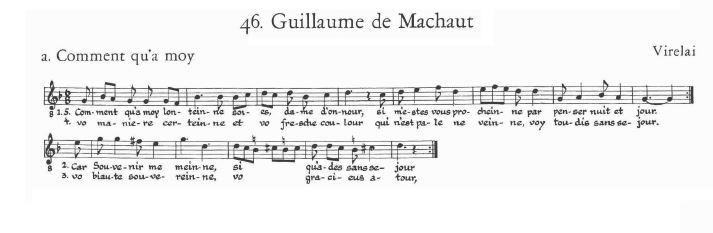
5: Virelai 5: (Commen Qu’ay Moy Lonteinne – However Far from me)
Very cool two part song, though I don’t love the second section so it’s coming in fifth. A few weird phrasing things that feel off to modern ears, but otherwise would be a great backbone for making the song your own with embellishments.
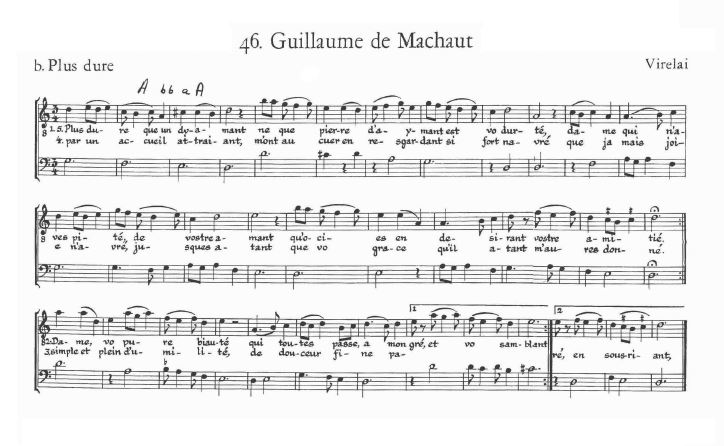
4: Virelai 31: (Plus Dure Qu’un Dyamant – Harder than a Diamond)
I had a hard time finding many non-vocal versions of this one, but at least I found the two part score for which I can try to come up with a guitar arrangement. Perhaps a little overlong for the ideas but definitely potential here to play with the early polyphony.
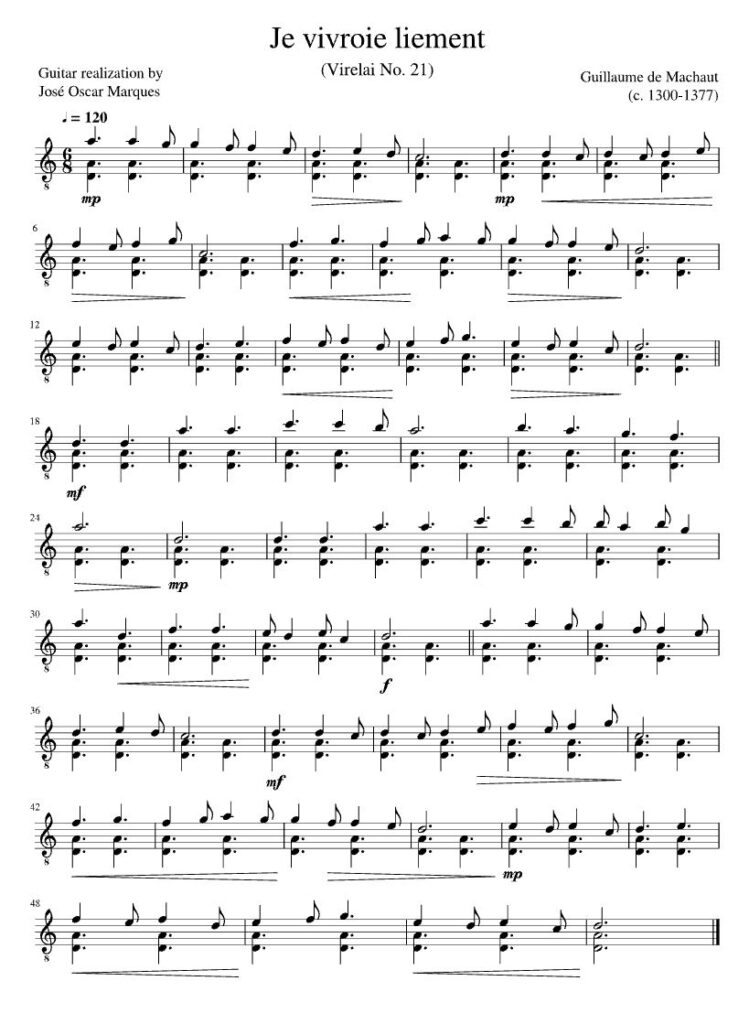
3.) Virelai 23: (Je Vivroie Liement – I would Live Joyfully)
This is one of the better arranged for guitar performances of this piece, though I knocked it down a place due to the guy in the video having a really stuffed up nose and being unable to resist donning a silly medieval hat. Otherwise a great song despite veering a little close to Irish jig territory.
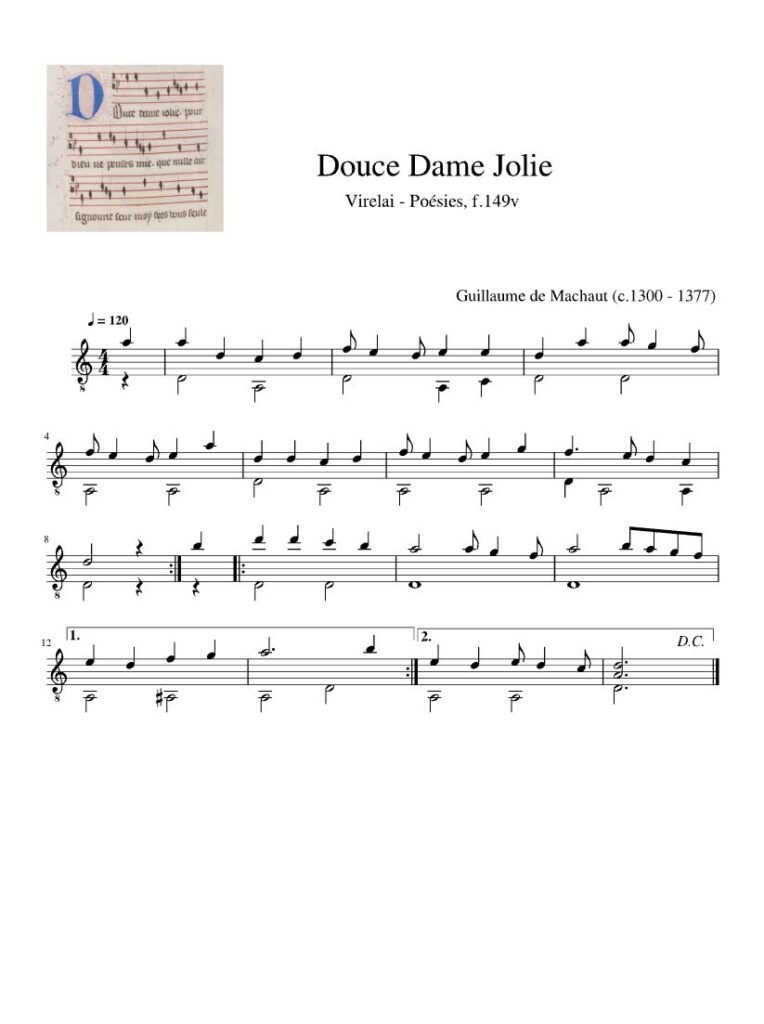
2.) Virelai 4: (Douce Dame Jolie – Sweet Pretty Lady)
Fantastic dancey song that flows very well and feels quite modern (especially in this arrangement). This is probably my favorite version I’ve found on youtube (the second song played on #5 above is another version of this and probably more historically accurate but does not flow as well) and it might have been first were it not for the silly hat tax.
1.) Virelai 13 (Quant Je Suis Mi Retour – When from Seeing my lady)
The best virelais basically just involve Machaut shouting “HEY LAAAAADY,” and this is no exception. Along with #2, this is one of the more famous virelai, and also one of the simpler ones. It can be jarring to hear a proper modern guitar arrangement which almost conceals its early music roots. But it’s a proper song (if quite simple/beginner friendly), full of nice little touches and a supremely mournful atmosphere, exactly what I look for in this stuff.